Allergen Guide for Packaged Snacks
Read the full ingredient list, where allergens are highlighted, then the "Contains" or "May contain" statement. Vegan and gluten free labels do not tell you whether a snack has nuts, soy or sesame.
The snack that fits in your bag should also be a choice you understand. This allergen guide for packaged snacks helps you read a label quickly, without guessing and without wasting time at the shelf. For someone with an allergy, a small word in the ingredients is not a detail. It is information that needs to be read clearly.
The good news is that you do not need to become a nutrition expert. You need to know where to look, what the main statements mean and when a pack does not give you the certainty you are looking for.
What counts as an allergen in a packaged snack
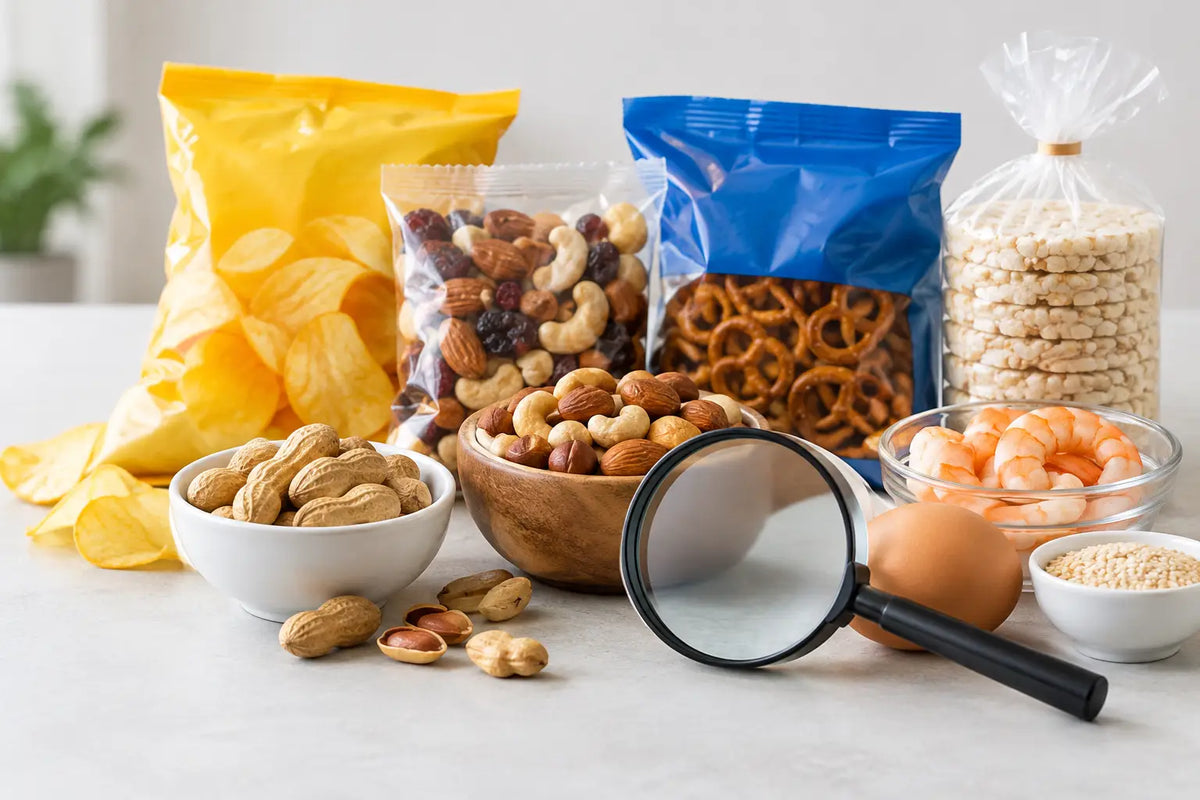
In the European Union there are 14 allergen groups that must be declared when they are used as ingredients. In snacks you often find them in forms that are not always obvious: milk powder or whey, soy in lecithin, nuts in a paste, sesame in a coating or cereals that contain gluten.
The label must highlight these ingredients within the list. You will usually see them in bold, in capitals or underlined. But do not stop at the front of the pack. That is where the quick messages are. The full answer is on the back, in the ingredient list and the allergen statement.
The 14 groups are cereals containing gluten, crustaceans, eggs, fish, peanuts, soy, milk, nuts, celery, mustard, sesame, sulphites, lupin and molluscs. Not all of them show up often in a bar or a pack of crackers, but it is worth knowing the full picture.
Allergen guide for packaged snacks: the right order to check
When you are in a hurry, it is easy to look only at whether a product says vegan, gluten free or no added sugar. This information can be useful, but it does not replace checking for allergens.
Start with the ingredient list. Read it from start to finish, even if you know the product or have bought it before. Recipes and production lines can change. If an allergen is used as an ingredient, it will usually be clearly highlighted.
Then look for the statement below or next to the ingredients. It may clearly say "Contains" followed by the allergens. There may also be a warning about possible presence because of a shared production line. Finally, check the date and make sure you are holding the same product and the same flavour you read about. Two similar packs do not always mean the same recipe.
This order takes less than a minute and lowers the chance of relying on a quick impression. Things you can pronounce are a good sign. Things you can check on the label are essential.
"May contain": what it really means
The phrase "may contain traces of" or "may contain" does not mean that the allergen is an ingredient in the recipe. It means there is a chance of accidental cross contamination, for example because other products are made in the same space or on the same equipment.
This statement needs to be taken seriously, especially when there is a diagnosed allergy or a history of strong reactions. It is not a general message to ignore because the product looks simple. The right choice depends on your allergist's advice and on your personal level of sensitivity.
There is also the opposite trap: the absence of "may contain" is not, on its own, a guarantee that a product is suitable for every case. Always read the ingredients too. For strict avoidance needs, contacting the producer or a health professional is more responsible than making an assumption at the shelf.
Vegan and gluten free do not answer everything
A vegan snack contains no animal ingredients, so it will not have milk or egg in the recipe. But that does not automatically tell you whether it contains peanuts, other nuts, soy or sesame. Plant ingredients often play the main role in modern snacks, and several of them belong to the main allergen groups.
In the same way, a gluten free label is about suitability for people who avoid gluten, and it is separate from the overall allergen check. It does not mean the product has no milk, soy, nuts or sesame. Each claim answers a different question.
This does not make the choice difficult. It makes it precise. Choose a snack for the features that work for you, but confirm that it also fits your personal dietary needs at that moment.
Watch for names that hide the obvious
Not all ingredients are written the way we say them every day. Milk can appear as milk protein, casein, caseinates or whey. Soy can be there as flour, protein, lecithin or soybean oil. Peanut can be listed as peanut butter or peanut paste.
With nuts, do not assume they are all the same. Almonds, hazelnuts, cashews, walnuts, pecans, pistachios and macadamias are different ingredients. If you avoid a specific nut, read the statement exactly as written, without generalising.
Sesame also deserves special attention. It can be in tahini, seeds or a coating. In snacks with cereals, biscuits and savoury bites, also check for mustard, celery or soy in spices, sauces and flavourings.
A practical routine for home, work and your bag
The easiest strategy is to have a few options you know well. Not because you have to eat the same things, but because repetition reduces stress when you rush from the office to class, to the gym or across town.
Keep a photo of the labels of the products you have checked, but check again every time you buy a new batch or a new flavour. A different flavour in the same range may have different allergens. If you buy online, do not rely only on the image of the front. Ask for or find the full, current label before you eat it.
At home, avoid moving snacks into empty containers without their packaging when someone in the family has an allergy. The packaging is the source of the information. If you want to organise them, cut out and keep the part with the ingredients or clearly note the product and the expiry date.
For Feel Good Bars, as with any packaged snack, always check the label of the specific flavour you are holding. Vegan, gluten free and no added sugar are features that make a choice clear, but the allergen statement is what gives you the personal answer.
The best label is not the one that promises the most. It is the one that lets you decide quickly and with a clear mind. Read it properly once and make your everyday snack a simple, confident choice.